
Lisette had woken before dawn, the shivering gray of the first hour slipping through the tall windows and lapping at the foot of her bed. The air was unmoving, thick with the scent of wood polish and the faint, unfathomable perfume her mother sometimes wore. She heard her mother’s footsteps in the hallway—deliberate, yet almost weightless—before the handle turned and the door opened upon her with the hush of a practiced hand. Lisette sat up, blinking away the memory of clay and wet laughter that still pressed heavy on her eyelids. Near midnight, Eric had lifted a lump of riverbed earth and plopped it atop her head, crowning her Empress of the Mudlands, and she’d thrown her head back and howled so loud that even the trees seemed to listen. She could still feel the cool, delicious slip of clay beneath her fingernails. The remnants still clumped in her hair, even after two baths.Her mother’s gaze was as severe as the cold pale dawn. “Come,” she said, and Lisette obeyed, slipping her feet into the slippers placed just so at her bedside, and padding after her across the icy tiles, skin prickling with each step.Mother led her to the washroom, already filled with clouds of steam from the kettle boiling on the hearth. She gestured at the stool by the basin, her face betraying nothing. Lisette, shivering in her shift, climbed atop it as her mother began to work at her hair. The bristles of the brush were sharp and unyielding, tearing through the knots of clay with the ferocity of someone who wished to punish the hair itself for its wildness. The water from the basin was near scalding; mother worked it into her scalp with deft, narrow fingers, scrubbing until Lisette’s skin burned and her eyes stung from the soap.“I can do it myself,” Lisette whispered. But her mother ignored her, tucking her chin and kneading the suds in deeper, as though she could scrub away every last vestige of this mornings play, every particle of riverbank, every trace of the girl Lisette had been before this silent morning.After the washing, her mother pulled out a towel, rough as sackcloth, and wound it around Lisette’s head, squeezing and twisting with an efficiency that almost hurt. She peeled the towel away with a single, practiced motion, leaving Lisette’s hair a dark, dripping mass. Then came the comb: a slow, methodical untangling. Lisette bit her lip until she tasted iron, but she said nothing, not when the comb caught or when her mother’s hands jerked at a stubborn snarl. She studied the pale lines of her knees, the splay of her toes on the tile. She felt the trembling of her own legs and pressed them together to hold still.At last, her mother straightened, her own face flushed from effort, and fetched the gown from a peg on the wall. It was not Lisette’s usual dress; not the thin, patchworked cottons or the limp linen with the mended sleeves. This was something altogether different—the weight of it alone was enough to draw a cry from Lisette’s lips. Her mother ignored the sound, instead holding the bodice wide and guiding Lisette’s arms into the sleeves.The fabric was a dark, bottomless blue, shot through with threads of silver that flashed only when the light hit just so, like moonlight on a restless sea. The skirt pooled on the floor in shimmering waves. The sleeves flared at the wrists, trimmed with pale blue piping. Lisette found her hands trembling inside the cuffs, her fingers lost in the folds.Her mother pulled the gown up to Lisette’s chin and began lacing the bodice. Each tug of the cord constricted Lisette’s ribs; by the time her mother finished, she could not take a full breath. She swayed a little on her feet, feeling the blood rush to her cheeks. The air seemed thinner, the world smaller.“You’re pinching me,” Lisette said, voice pinched itself.Her mother paused, then loosened the laces by a hair, just enough to permit air but not comfort. “We want it to fit,” she said. “We want them to see how well you mind yourself.”Lisette nodded, though she did not understand. She had begun to piece together the elements of the day—her mother’s silence, the ceremonial dress, the absence of her brothers at breakfast, the way the curtains had been drawn and the clocks covered with cloth. She wondered if it was a feast day she’d forgotten, or if the news from the capital had been even graver than her father let on. She tried to recall the exact phrasing of the last letter, but all she remembered was the way the paper had trembled in her mother’s hands as she read it aloud.Then her mother turned Lisette toward the mirror. She stood behind her and began to braid her hair, starting at the crown and weaving in sections with a precision that was almost mechanical. The braid was pulled so tight Lisette’s brow arched, her eyes wide and almost startled in her own reflection. Her mother’s fingers paused at each segment, tucking in stray hairs, smoothing with a touch that was at once gentle and hurried. There was a desperation to her movements—as though the very act of braiding might hold the world together for another moment.They stood like this for a while, mother and daughter, the only sound the clinking of comb against hair and the occasional drip of water from the ends of Lisette’s braid. The silence in the room thickened, became heavy, until it pressed up against Lisette’s sternum.Her mother finally finished the braid and tied it with a length of a matching blue ribbon. She brushed her hands over Lisette’s shoulders, swept invisible motes from the bodice, then reached down to turn up the hem of the gown. “You’ll need to be careful not to trip,” she said softly.Lisette bit the inside of her cheek. She wanted to ask, “Where are we going?” but something in her mother’s face warned her off it. She remembered how, the night before, her mother had sat on the edge of her bed and stroked the back of her hand, wordless and distracted, all the while staring at the moon through the frost-etched window pane. There had been something final in the way she pressed a kiss to Lisette’s temple and lingered there, inhaling the scent of her hair as if committing it to memory.Now, her mother knelt beside her and reached for the pair of gloves on the dresser. They were white, so white Lisette feared she would stain them just by wearing them. Her mother slid them onto Lisette’s hands, tugging each finger into place, then folded her own hands over Lisette’s for a brief, fierce moment. “You are beautiful,” she said, and her voice was so small it seemed borrowed from someone else. Lisette could feel the tremor in her mother’s hands, and when she looked up, she saw tears gathering in the corners of her mother’s eyes.“Why are you crying?” Lisette asked.Her mother blinked quickly, then released her hands, standing so abruptly the chair scraped across the tiles. She wiped her face with her sleeve and set her mouth in a thin line. “I’m not crying,” she said. “I’m just proud of you. That’s all.”Lisette swallowed, feeling the question rise again in her throat. But instead, she nodded and stood, swaying a bit in the unfamiliar shoes. Her mother placed a hand on her shoulder to steady her, then drew her toward the parlor with a briskness that left no space for hesitation.In the parlor, the curtains were drawn tight, and the only light came from the eastern windows, where dawn had surrendered to a faint, uncertain gold. On the table lay a single envelope, its creamy surface marred by the dark blue wax seal of the Empire. Next to it was a small brooch—an enamel forget-me-not, its petals a perfect match for Lisette’s new gown. Her mother picked it up and pinned it to the bodice, just over Lisette’s heart.“There,” she said, voice steadier now. “You must remember to keep your head high. And smile, if you can.”Lisette nodded, but her hands trembled, and it seemed the world had tilted on its axis. She let herself be led to the window, where her mother straightened her collar and fussed over the set of her shoulders. She could hear the distant sound of wheels on cobblestones, the lowing of oxen, the calls of merchants in the square. Somewhere, deep inside her, the truth began to coalesce: this was a morning of departure, not celebration.She closed her eyes, trying to recall the riverbank, the laughter, the way the earth had squelched between her toes. She tried to hold onto that part of herself as the cold blue silk pressed in on all sides, as her mother’s hands guided her into a new shape.Through the mirror’s silvered glass, Lisette watched her reflection transform: a little girl melted away, replaced by someone older, poised, and awkward in grown-woman’s finery. Then she turned her gaze past that image to rest on her mother’s face in the glass. Mother looked away as though her daughter had become a stranger. Lisette’s chest tightened. She rose from the chair, heart fluttering like a captive bird. “You’re truly not coming?” The words trembled into the stillness, softer than she meant.
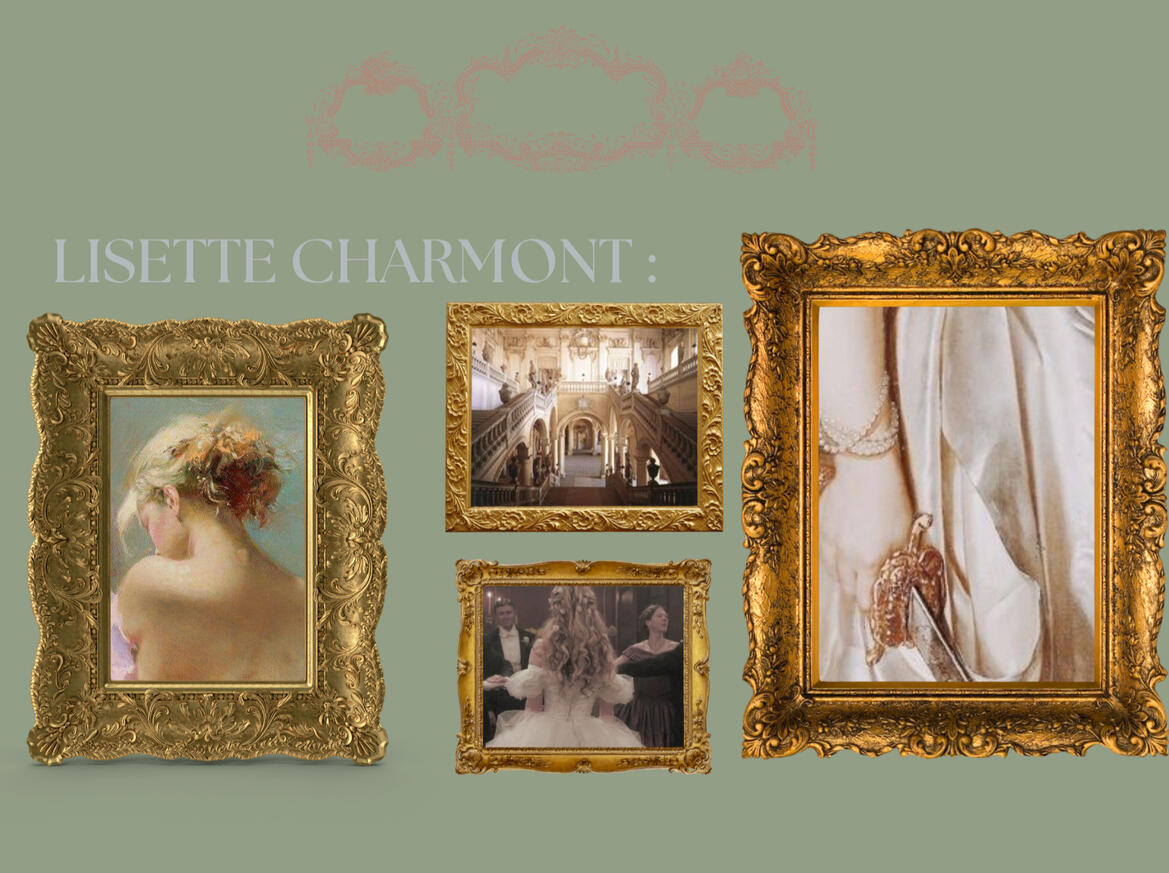
Lisette stands barely five feet five inches tall, yet her presence feels larger than her frame. Her face is sculpted with a sharply defined jawline that contrasts with the gentle slope of her soft cheekbones. Dimples slip into view only when she smiles—rare, like secret invitations—or when she speaks and the corners of her mouth catch in fleeting arcs. Her almond-shaped eyes tilt ever so slightly upward at the outer corners, painted in a pale blue so close to gray that they seem to draw shadows inward.
Beneath them, the faint hollows of deep eye bags lend her an inscrutable intensity, as though every unspoken thought pools beneath her lashes.Her lips are plush and inviting, the upper one curving into a perfect cupid’s bow and resting just above a slightly fuller lower lip. When she parts them, her words drift out on a gentle current of sound. Lisette’s strawberry-blonde hair tumbles in unruly waves and curls to her shoulder blades, each strand silky and cool under a fingertip, redolent of rose petals and vanilla bean. Pale as brushed porcelain, her skin is stretched over a slender silhouette that cinches dramatically at the waist and flattens to a taut stomach. Just under her right eye, a lone dark freckle punctuates her complexion like a whispered secret.There is something inscrutable in Lisette’s bearing: a perpetual veil of mystery that keeps her thoughts locked inside. She moves and speaks with a surprisingly soft, feminine tone that belies the steely calculation behind her gaze. Always observing, always measuring her surroundings, she thinks several steps ahead, solving puzzles in silence. Quick to learn and adaptable by nature, Lisette weaves through new situations with an almost preternatural ease. Though she can seem distant—aloof even—those who earn her trust discover a well of compassion beneath the élan, a warmth that humanizes her and tethers her enigmas to empathy.Lisette’s world has long been defined by the grey stones of Castle Adurant, where she was raised alongside her three elder brothers. Behind those ramparts lay only shadows and hush, for her mother never spoke of life beyond the walls. On rare bright mornings she would stand a few cautious paces from the drawbridge, a guard’s spear always in view, as her father and brothers rode away on hunts that she yearned to join. From her earliest memories, Lisette longed to slip through the gates and discover what lay beyond the horizon. Sensing her restless heart, her brothers trained her in the arts of combat as she grew, sparing her no hardship. They knew the perils that prowled the untamed lands—and they would have her ready for whatever waited outside.